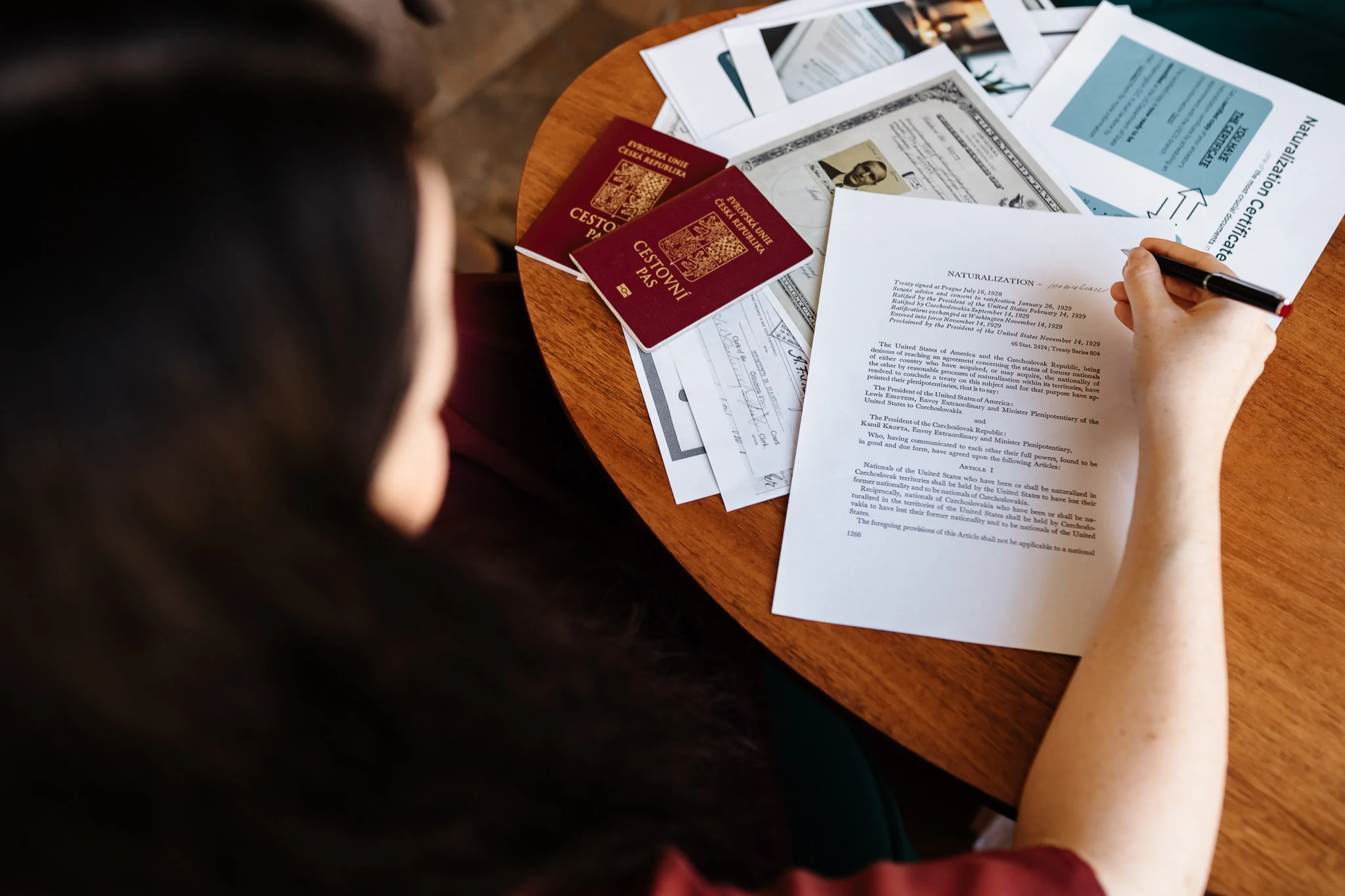

The laws have changed many times over the last century, and the circumstances of each family — from marriages and emigration to naturalization abroad — can make a crucial difference. That is why we always offer a careful pre-assessment of your case as the first step run by our cooperating specialised attorneys.
A pre-assessment gives you a realistic view of your chances before you begin collecting documents or submitting an application.
What Factors Do We Examine?
When we start preparing the pre-assessment, we begin by asking the most basic question: was your ancestor ever a Czechoslovak citizen in the first place?
This may be a crucial question not only for those born before 1918, that is, before the establishment of Czechoslovakia, but also for many others. In the case of individuals born before 1918, it is necessary to determine whether they later met the legal criteria for acquiring Czechoslovak citizenship. However, the complexity does not end there. Even if an ancestor was born within the territory of Czechoslovakia after 1918, it is essential to consider the impact of later historical developments, such as the separation of Carpathian Ukraine after World War II or the federalisation of Czechoslovakia in 1969.
In a typical pre-assessment, we also review the following points:
- Marriages
Earlier laws often tied women’s citizenship status to their husband’s nationality, but exact rules changed several times over the modern history.
- Emigration and loss of citizenship
Contrary to what many people believe, leaving Czechoslovakia usually did not automatically mean losing citizenship. Formal release had to be granted, or in many cases, loss came through naturalization in another country.
But even here, the details matter: a treaty between Czechoslovakia and the United States dealing with loss of citizenship, for example, meant that timing was crucial in deciding exactly when and whether citizenship was lost. In some cases, people kept their citizenship longer than expected; in others, they lost it earlier.
We also need to look at the broader historical picture. After World War II, the Beneš Decrees might have stripped citizenship from people of German or Hungarian background unless they could show resistance to the Nazi regime or persecution during the war.
Later, in 1969, when Czechoslovakia was divided into the Czech and Slovak Socialist Republics, it became necessary to determine whether an ancestor was considered Czech or Slovak. This can still affect eligibility today, and perhaps surprisingly, may even broaden the available citizenship options for descendants. As mentioned, special treaties also applied to certain regions, such as Transcarpathian Ukraine, where residents might have lost their Czechoslovak citizenship when the territory was transferred to the Soviet Union.
- Transfer of citizenship
In many cases, the outcome of the pre-assessment is that the client is actually a Czech citizen by birth – often without even realising it. This is because the citizenship chain remained unbroken and the status was passed down from generation to generation, beginning with an ancestor who last resided in the Czech lands. Even so, the relevant laws have changed several times, setting different criteria for whether a child could inherit Czech or Czechoslovak citizenship at birth. That is why we carefully examine the birth dates and places of all relevant family members, along with other factors that may play a crucial role.
How Do We Work?
Our pre-assessment is not just a quick check of a family tree. With help of our cooperating attorneys, it is a professional legal analysis that combines:
- Document review – civil records provided by you.
- Legal research – applying the historical laws in force at the time of each relevant life event.
- Official verification – contacting Czech authorities where necessary to clarify uncertainties.
- Contextual assessment – considering whether issues like the Beneš Decrees, war treaties, or shifting borders may affect your case.
We then prepare a structured overview, summarizing:
- what is known,
- what assumptions may need to be made,
- what risks or complications exist, and
- whether your claim under the current Czech Citizenship Act (especially § 31 or § 32) seems realistic.
The result of this process is a clear, reasoned overview that tells you where you stand: whether your ancestor likely held Czechoslovak citizenship, whether and when they lost it, and whether their loss creates a valid path for you to apply under the current Czech Citizenship Act. We also point out where uncertainties exist, and what additional records might be necessary to resolve them.
For you, this means you can move forward with a realistic picture of your chances. If the path is clear, we can then help you with every step of the application: preparing a tailored list of required documents, checking everything for compliance, arranging translations, drafting the application and a detailed explanation, and communicating with the Czech authorities on your behalf.
In short, the pre-assessment is the foundation of the entire process, and it determines who is eligible for Czech citizenship. It is where family history meets legal history, and where we determine whether the pieces truly fit together to support a claim. While many people qualify under the law, each case requires careful attention to detail, and our role is to give you clarity and confidence before you begin the formal application.
Citizenship by descent can be a wonderful way to reconnect with your Czech heritage, but it is also a complex legal matter shaped by history, treaties, and changing laws. Our pre-assessment ensures that you understand where you stand before moving forward, and that your claim is built on solid ground.
Not sure if you are eligible for Czech citizenship? Let’s find out together. Request your pre-assessment today.